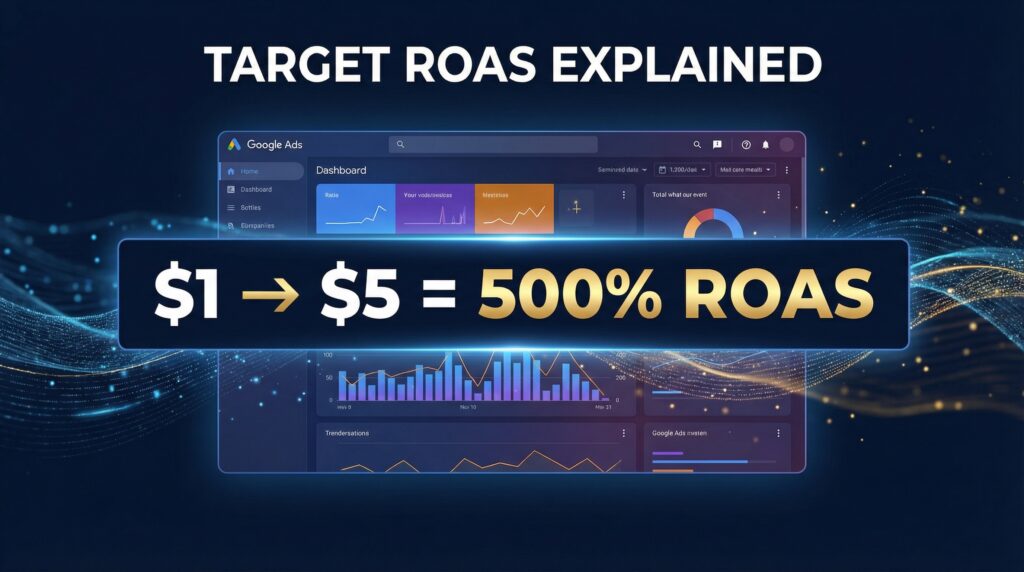
Here’s something I see constantly: business owners running Google Ads with a tROAS target they picked almost at random — usually a number that “sounds good” — and then wondering why their campaigns won’t spend or why their results are all over the place.
Let me clear this up.
What Target ROAS Actually Is
Target ROAS — tROAS — is a Smart Bidding strategy where you tell Google’s AI exactly how much revenue you want back for every dollar you spend on ads. That’s it. The formula is dead simple:
Conversion Value ÷ Ad Spend × 100 = ROAS %
So if you set a 500% tROAS, you’re telling Google: “I want $5 back for every $1 I spend.” Google then uses its AI to adjust your bids in real time — every single auction — based on the likelihood that the click will generate that value. High-value opportunities get aggressive bids. Low-value ones get suppressed or skipped entirely.
What’s doing all this math? Google’s algorithm processes over 70 million auction signals per day — device type, location, time of day, browser, search query, audience lists, and more. Every time your ad has a chance to show, Google runs a prediction on expected conversion value and adjusts your max CPC accordingly.
That’s actually impressive. When it works, it’s one of the most efficient ways to run ads.
The Part Nobody Warns You About
Here’s where it gets tricky. The algorithm needs data to predict accurately. Specifically — and I cannot stress this enough — you need at least 50 conversions per month before tROAS becomes reliable. Below that threshold, the AI is essentially guessing, and you’ll see erratic performance: weird spend spikes, unexplained drops, conversions all over the place.
If you’re not hitting 50 conversions a month yet, run Maximize Conversion Value first. Build that conversion history. Then graduate to tROAS once the algorithm has enough to work with.
Setting Your Target: The Rule I Follow
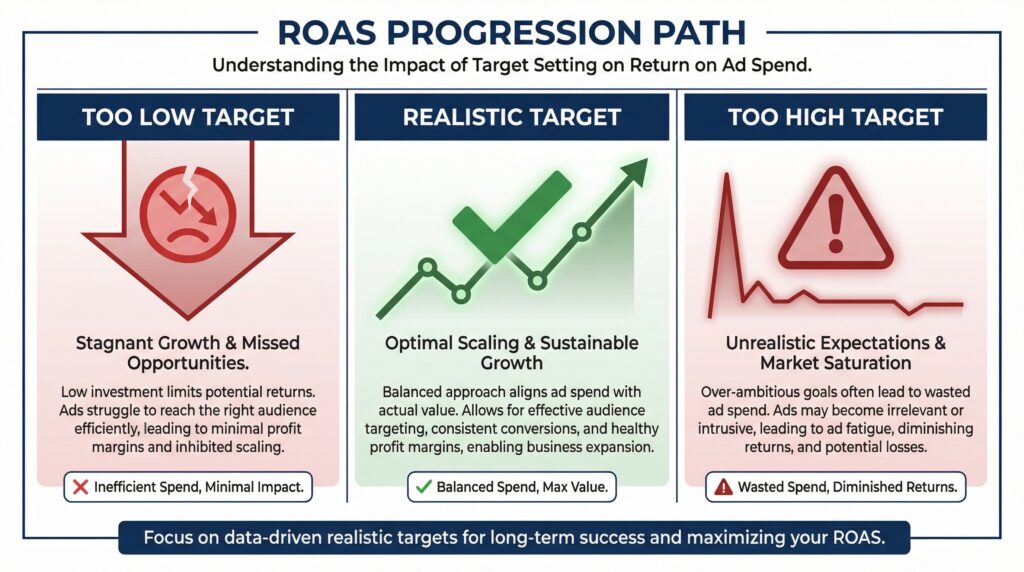
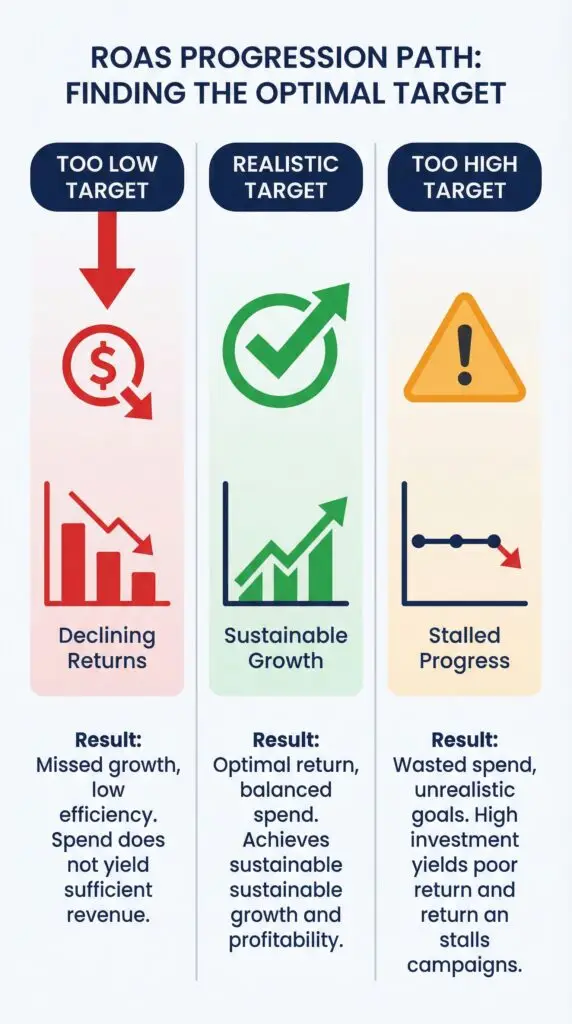
This is the most common mistake I see — setting a tROAS target based on what you want rather than what’s actually happening. If your campaigns have averaged 300% ROAS over the last 30 days, setting a 600% target doesn’t make Google try harder. It makes Google stop bidding.
The algorithm interprets an unrealistically high target as “only bid when I’m nearly guaranteed this return.” Since those perfect auctions are rare, your impressions collapse — and so does your revenue.
The rule: start your tROAS at your real 30-day historical ROAS, or 10–15% above it at most. Then, once performance stabilizes (give it at least two weeks), increase by 20% increments. Slow and steady here genuinely wins.
One more thing — don’t touch the target constantly. Every significant change triggers a learning period that can last up to two weeks. Multiple changes in quick succession mean your campaign is perpetually “learning” and never actually optimizing.
Quick Gut-Check: Is tROAS Right for You?
Not every account should be on tROAS. It makes the most sense when your conversion values vary — like an e-commerce store selling products at different price points. If every conversion is worth the same amount, Target CPA is simpler and works just as well.
And if your margins are tight, here’s a useful calculation: divide 1 by your gross margin percentage to find your breakeven ROAS. If your margin is 25%, your breakeven is 400%. Your tROAS target must be above that number, or every sale is technically losing money.
Bottom line — Target ROAS is a powerful strategy, but it rewards patience and realistic expectations. Set it right, give it time, and review it monthly as your business and margins evolve.
Need a second pair of eyes on your current bidding setup? I offer free Google Ads audits and can tell you in about 30 minutes whether your tROAS target is helping or hurting you → https://www.upwork.com/freelancers/nazdiocampoaimarketing