I’ve been getting this question almost every single week lately: “Should I use Performance Max or Search campaigns?”
And honestly? I get why people are confused. Google keeps rolling out updates, the lines between campaign types are blurring, and there’s a ton of conflicting advice floating around. So let me cut through the noise and give you the framework I actually use with clients.
Search Campaigns: Your Precision Tool
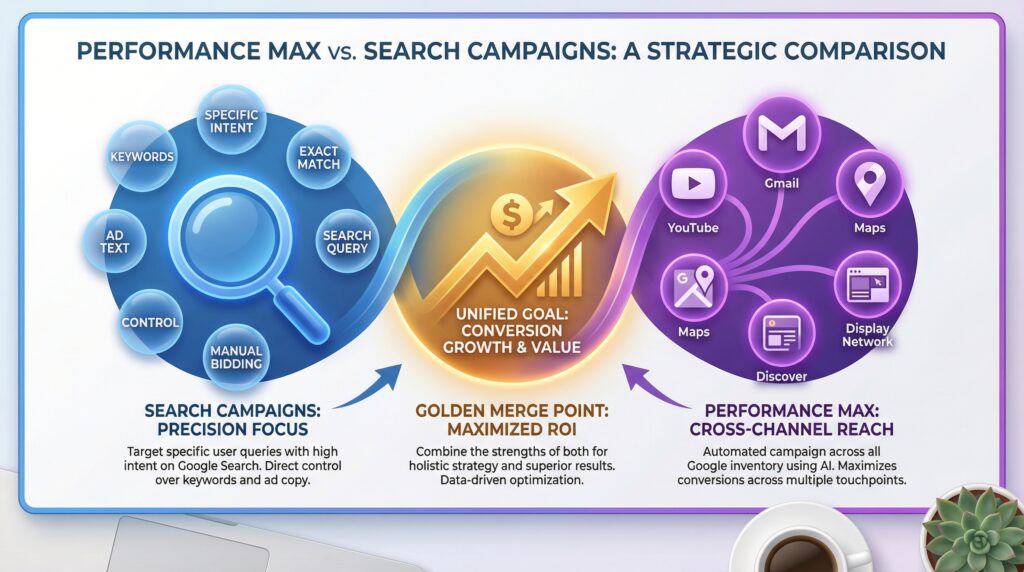
Search is still the king of intent. Period. When someone types “personal injury lawyer near me” or “best project management software for agencies,” they’re not browsing. They’re buying.
Search campaigns let you control the entire experience — which keywords trigger your ads, what copy shows up, and exactly which landing page they land on. That tight alignment between query, ad, and landing page is still the most reliable way to convert high-intent traffic.
I recommend Search as your starting point if you’re doing B2B lead generation, selling high-ticket services, working with a limited budget, or if you just need clean data to understand what’s working. Search gives you that granular, keyword-level reporting that PMax still can’t fully match.
Oh, and here’s something a lot of people overlook — if your conversion tracking isn’t rock-solid yet, stick with Search. It’s way more forgiving when your data signals are still being built up.
Performance Max: Your Scale Engine
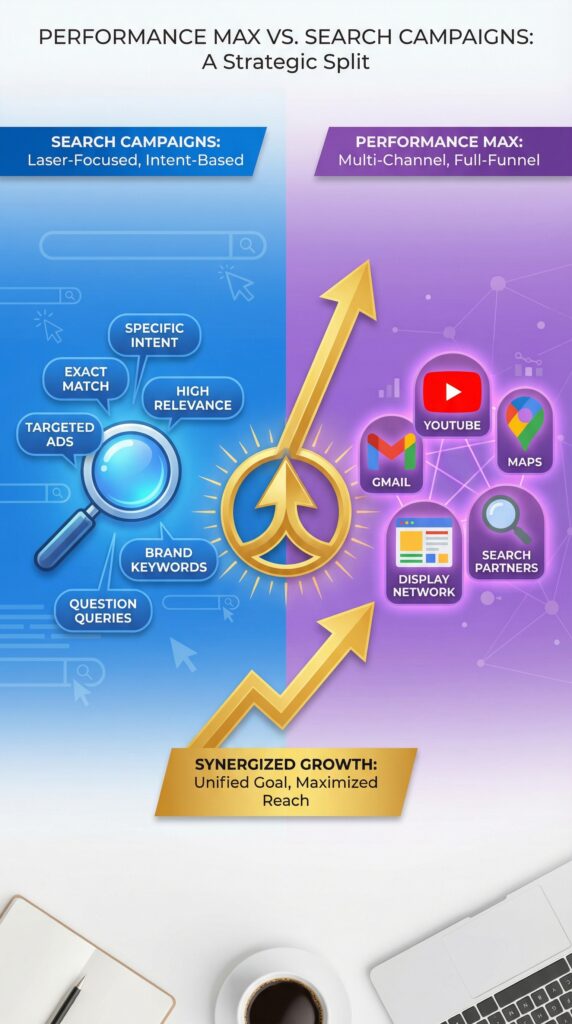
PMax is a completely different animal. Instead of targeting specific keywords, you’re feeding Google a goal — say, maximize purchases or generate leads — along with creative assets and audience signals. Then it runs your ads across Search, Shopping, YouTube, Display, Gmail, Maps, and as of late 2025, even Waze.
That cross-channel reach is where PMax shines. It’s phenomenal for e-commerce businesses with a product feed, brands looking to expand beyond Search traffic, and anyone who wants to reach people at different stages of the buying journey — not just the bottom of the funnel.
Here’s the thing though. PMax is only as smart as the data you give it. If your conversion tracking is messy, your creative assets are weak, or you’re not generating at least 30-50 conversions per month, PMax is going to struggle. It needs a data runway to work properly.
The 2026 Game-Changer: Transparency
One of the biggest knocks against PMax used to be the “black box” problem — you couldn’t see where your money was going. That’s changed dramatically.
As of early 2026, Google has rolled out channel-level reporting so you can finally see exactly how much of your PMax budget goes to Search vs YouTube vs Display. You can now add up to 10,000 campaign-level negative keywords. And the new placement reporting lets you see which specific domains and placements are getting your impressions.
That’s a massive shift. It means you can actually govern PMax now instead of just hoping the algorithm gets it right.
The Real Answer: Run Both
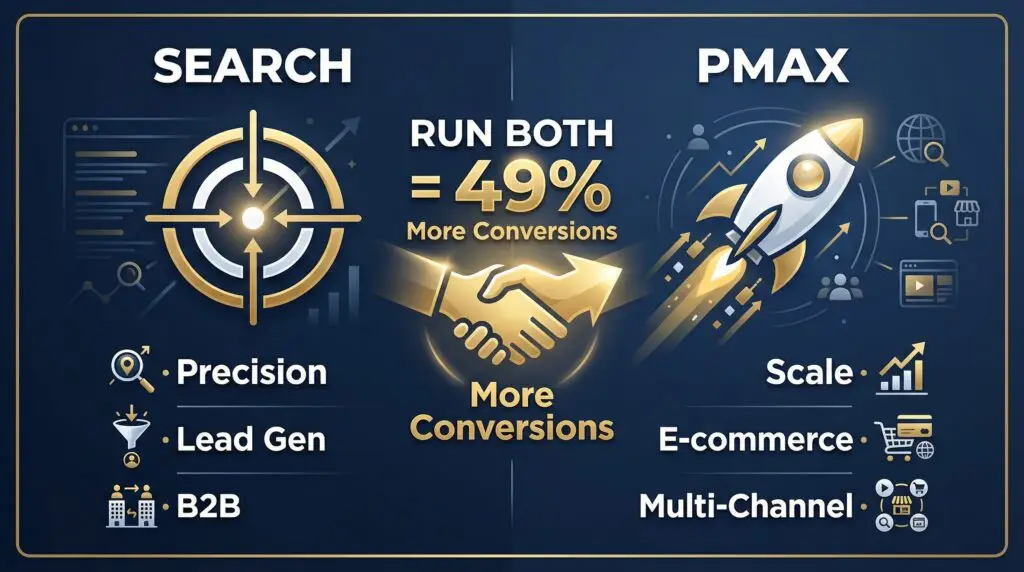
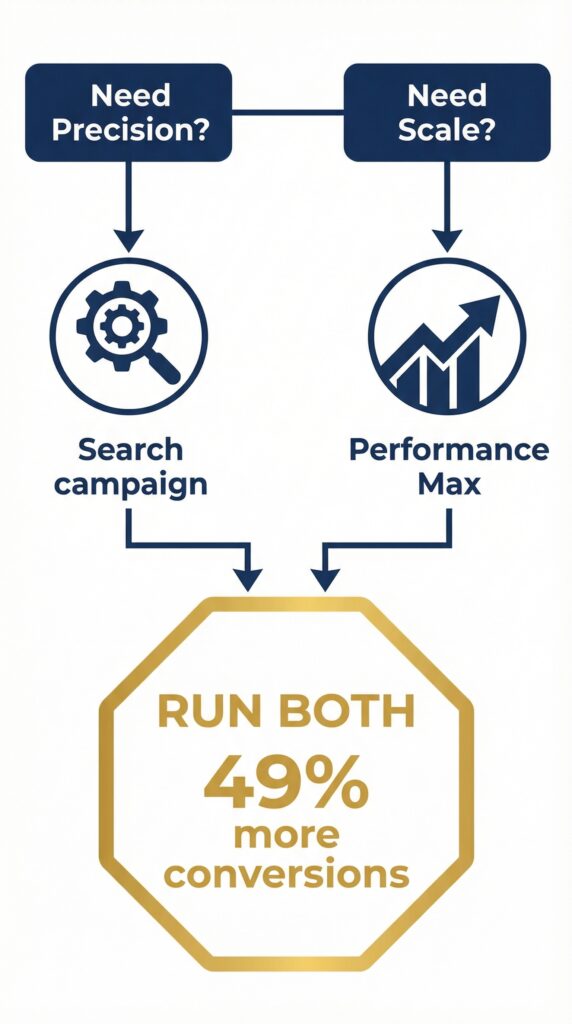
Here’s what I tell every client — and what the data supports. The best Google Ads accounts in 2026 aren’t picking one campaign type. They’re running both with clearly defined roles.
Search handles the harvest. Your brand keywords, your top-converting non-brand terms, your highest-intent queries — those stay in Search where you have full control. PMax handles the expansion. New customer acquisition, cross-channel remarketing, product feed scale, audiences who don’t know you yet — that’s PMax’s job.
And the results are hard to argue with. Data from late 2025 shows this hybrid approach driving up to 49% more conversions at 33% lower cost per acquisition compared to PMax-only setups. That’s not theory — that’s real account data.
The Quick Decision Framework
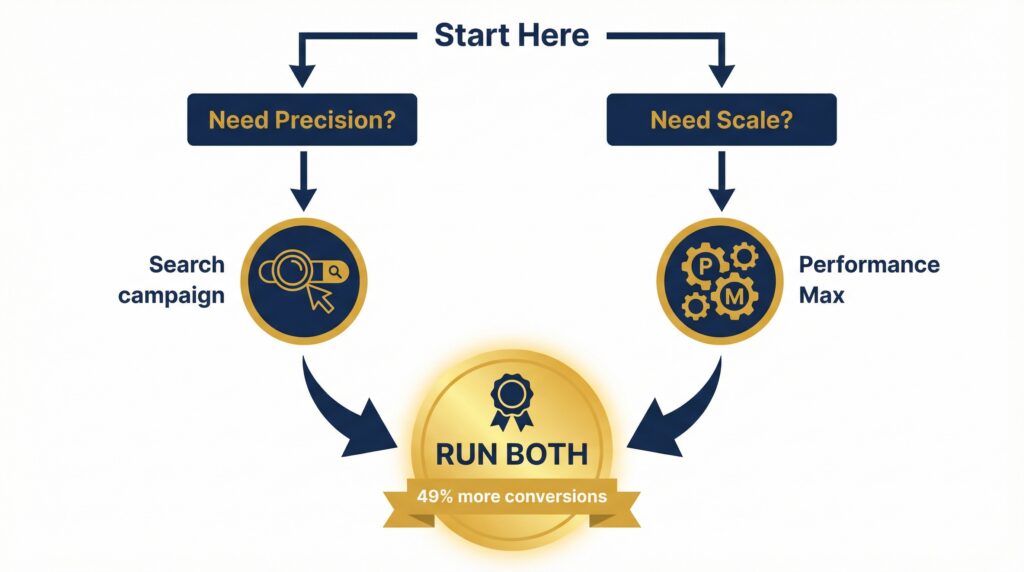
If you’re still unsure, ask yourself these questions:
Do I need strict control over which queries trigger my ads? Start with Search. Am I generating enough conversions for the algorithm to learn? If not, Search first. Do I have strong creative assets — images, video, multiple headlines? PMax can put those to work. Have my Search campaigns plateaued and I need new growth? Time to add PMax.
And if you can say yes to having clean tracking, solid creative, and stable conversion volume? Run both. That’s where the magic happens.
Look — the PMax vs Search debate is honestly kind of outdated at this point. The smart play in 2026 is understanding what each one does best and giving them separate jobs in your account. Stop treating it like a competition and start treating it like a team.