Most Google Shopping advice out there is built for the $20-impulse-buy crowd. And look — that’s fine if you’re selling phone cases or novelty mugs. But the second you try to apply that same playbook to a $1,500 office chair or a $3,000 espresso machine? It falls apart. Fast.
I’ve managed Shopping campaigns across all kinds of price points over the past 8+ years, and I can tell you — high-ticket is a completely different animal. Not harder, necessarily. Just different. And if you don’t adjust, you’ll hemorrhage budget wondering why your ROAS looks like a dumpster fire.
So here’s what actually changes when you’re selling premium products through Google Shopping.
Your Product Feed Isn’t Just Data — It’s Your Sales Pitch
For a $20 product, a mediocre title might still get a click. At $2,000? No chance. High-ticket buyers are doing serious comparison shopping. They want specifics before they’ll even consider clicking — and every click at this price range is expensive.
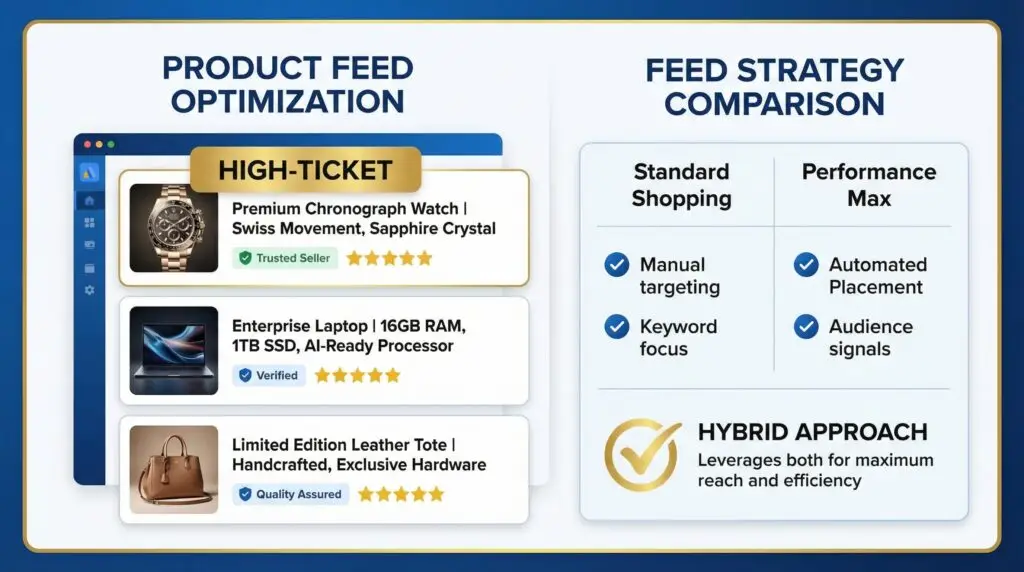
Here’s what I tell my clients: think of your product title as a mini value proposition. Not just “Ergonomic Office Chair” but “Herman Miller Aeron Size B – Graphite Frame – Fully Adjustable Arms – 12-Year Warranty.” That level of detail pre-qualifies the click. The person who clicks that title already knows exactly what they’re looking at — which means they’re far more likely to convert.
And it’s not just titles. Fill in every attribute Google gives you. Material, finish, dimensions, certifications, lifestyle tags. In 2026, Google’s AI is pulling from all of this data to match your product with buyer intent. The richer your feed, the smarter the matching.
Oh, and use custom labels. Seriously. Tag your products by price tier and margin band using custom_label_0 through custom_label_4. This lets you build separate campaigns for your $500 products versus your $2,000+ products — because they absolutely should not share the same bidding strategy.
Trust Signals Win — Not Discounts
Here’s something that trips up a lot of e-commerce teams: high-ticket buyers aren’t shopping for the lowest price. They’re shopping for the lowest risk.
Think about it. If you’re about to drop $2,000 on something, you’re not looking for a coupon code. You’re looking for proof that this is the right decision. That the product is legit. That the company will back it up if something goes wrong.
That means seller ratings are non-negotiable. Get set up with a Google-approved reviews partner — Trustpilot, Okendo, whatever fits your stack — and start collecting reviews. Star ratings on Shopping listings are one of the highest-impact trust signals available to you.
Beyond that, make sure your Merchant Center reflects every trust badge you can claim. Free shipping. Easy returns. “2-Year Warranty.” Price drop annotations. For high-ticket products, a clear warranty mention in the description can convert better than a 10% discount — I’ve seen it happen multiple times.
And don’t forget your landing page. The Shopping ad gets the click, but the product page closes the sale. Reviews, warranty details, return policies, professional imagery, financing options — all of that needs to be front and center. If your product page doesn’t “close the trust gap,” it doesn’t matter how good your campaign is.
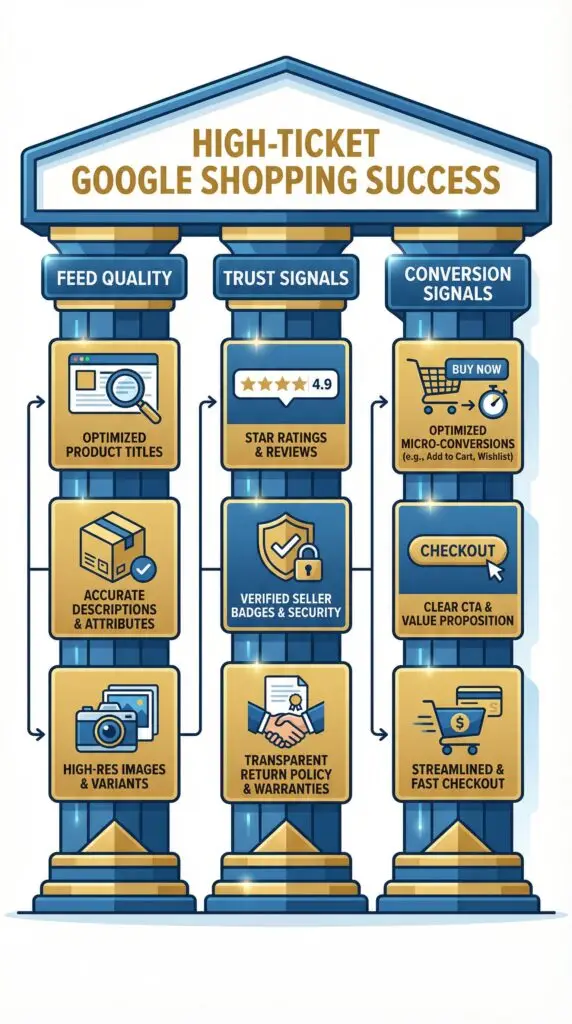
Solving the Conversion Desert
This is where high-ticket Shopping gets tricky from a technical standpoint.
Google’s Smart Bidding — whether that’s Maximize Conversion Value or Target ROAS — needs data to learn. Specifically, it needs conversion volume. And when you’re selling $2,000 products, you might only get 5-10 purchases per month. That’s just not enough signal for the algorithm to optimize effectively.
So what do you do? You build what I call a “signal ladder.”
Your primary conversion stays as the purchase — with the correct value attached. But you layer in secondary micro-conversions that predict purchase intent. Things like add-to-cart, “request a quote,” brochure downloads, or chat initiated. These give Google’s algorithm additional data points to learn from, even when actual purchases are sparse.
And here’s a move that most people sleep on: Conversion Value Rules. You can tell Google that a visitor from a specific high-income area, or a returning visitor, is worth 2x more than a cold first-time visitor. This weights the auction in your favor even when sales volume is low.
One more thing — extend your attribution window. Standard 7-day windows will absolutely miss value on high-ticket products because buyers research for weeks before converting. Bump it to 28 or 60 days and you’ll finally see what your Shopping campaigns are actually driving.
The Hybrid Campaign Play
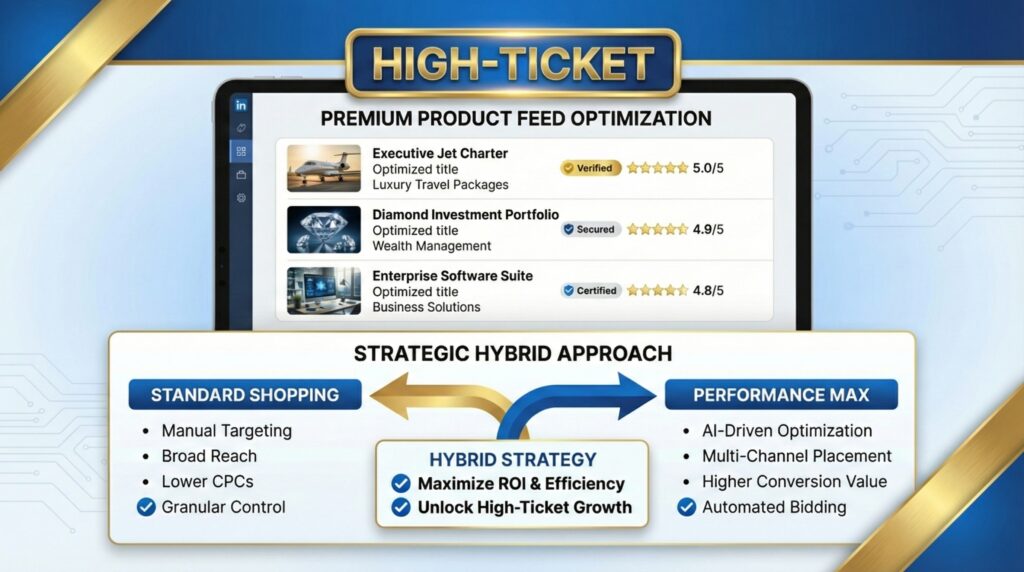
I’ll be honest — Google really wants everyone on Performance Max. And PMax can work great… when it has enough data. The problem? High-ticket products often don’t generate the 20-30 monthly conversions PMax needs to optimize well.
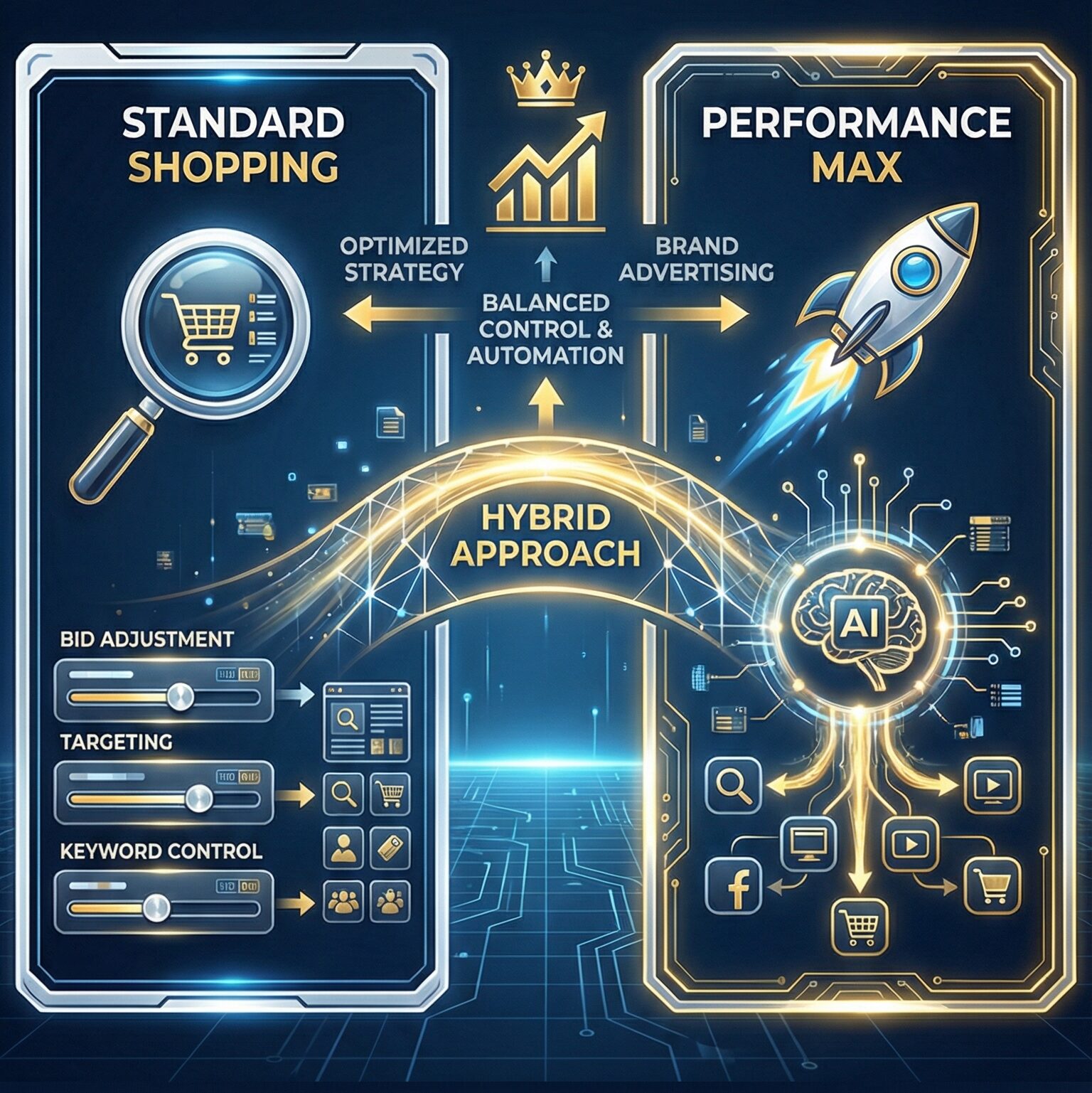
So the move in 2026 is a hybrid approach. Keep your bread-and-butter premium SKUs in Standard Shopping, where you get granular control over search queries, placements, and bids. Then use Performance Max for your higher-volume, entry-level products that can actually feed the algorithm enough data.
Standard Shopping gives you visibility. PMax gives you reach. Together, they cover the full funnel without burning budget on placements that don’t convert.
The Bottom Line
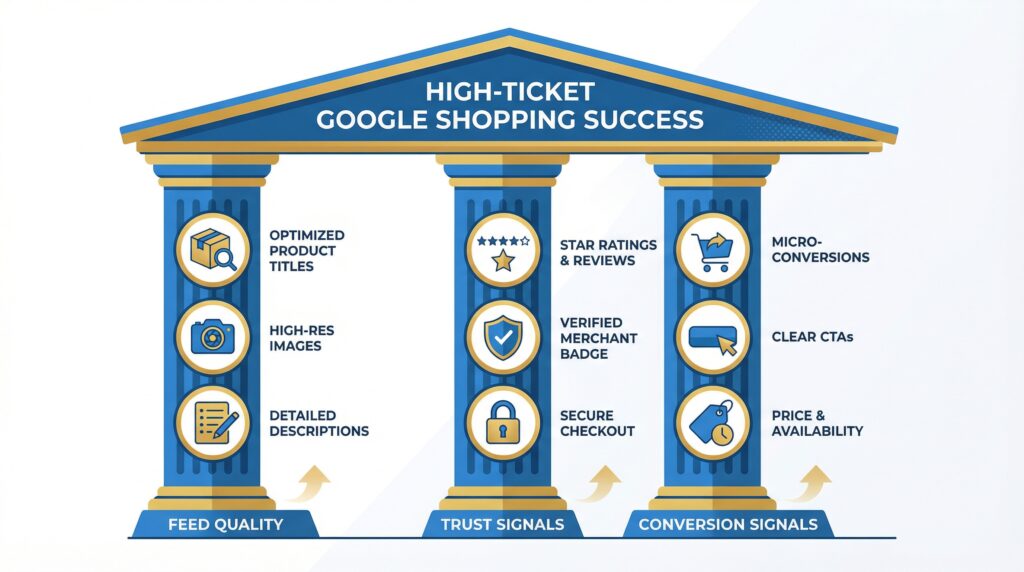
High-ticket Google Shopping isn’t about spending more. It’s about being smarter with how you set up feeds, build trust, generate signals, and structure campaigns. Get these four things right, and you’ll stop competing on price and start competing on value — which is exactly where premium brands should be.
Take 20 minutes this week. Audit your feed titles, check your trust signals in Merchant Center, review your conversion actions, and look at your campaign structure. I’d bet money you’ll find at least one major gap.
Need help setting up Google Shopping for your high-ticket products? I’ve spent 8+ years helping e-commerce businesses stop wasting money and start getting real returns on premium products. Let’s talk → https://www.upwork.com/freelancers/nazdiocampoaimarketing