Let me kill a myth right out of the gate.
Google Ads management is not “set it and forget it.” It never was — but that phrase has done more damage to advertising budgets than any bad keyword ever could. Business owners hear it, believe it, and then wonder six months later why their account burned through $30K with nothing to show for it.
I’ve been managing Google Ads for over eight years. I currently handle six-figure monthly ad budgets across multiple industries. And the daily reality of this job in 2026 looks nothing like what most people imagine.
Here’s what actually happens.
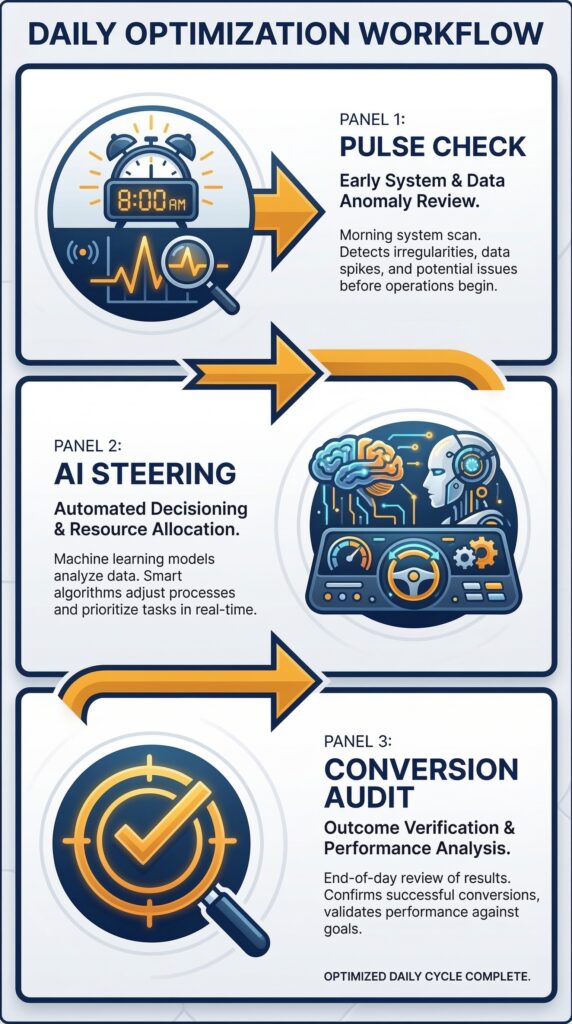
The Pre-Coffee Pulse Check
My day starts before my clients are awake. That’s not me being dramatic — it’s just practical. Google Ads doesn’t sleep. Auctions shift overnight. Competitors enter and exit. Tracking breaks. Budgets pace incorrectly.
So every morning, the first thing I do is run what I call the pulse check. It’s a quick scan — usually 15 to 30 minutes per account — that covers spend pacing, conversion volume, impression trends, and anything that looks abnormal compared to the previous day.
Did spend spike 40% overnight? That could mean a competitor dropped out and Google’s algorithm rushed to fill the gap with your budget. Did impressions crater? Maybe an ad got flagged for a policy violation or a keyword got paused accidentally. Is there a conversion spike that looks too good to be true? It probably is — could be a tag firing on page load instead of on actual purchase.
These things happen constantly. The difference between catching them Monday morning versus discovering them Friday afternoon is often thousands of dollars.
Google also changed budget pacing behavior in early 2026 for campaigns using ad scheduling. The system now pushes more aggressively to spend up to the 30.4x monthly cap during your scheduled windows. So if you’re not watching daily pacing, you might hit budget limits way earlier in the month than expected.
I also lean on Google’s Ads Advisor during this phase. It’s Google’s AI assistant built directly into the platform, and it’s become part of my daily toolkit. I’ll type something like “Which campaigns saw a CPA increase above 15% yesterday?” and get an instant diagnostic. It doesn’t replace my judgment — but it surfaces data faster than clicking through 30 different campaign views manually.
Mid-Morning: Creative Directing the AI
This is where the role has changed the most from what it looked like even two years ago.
In 2026, Google’s AI controls bidding, audience targeting, creative assembly, and placement decisions. Performance Max runs across Search, Display, YouTube, Gmail, Discover, and even Waze simultaneously. AI Max for Search generates ad variations on the fly based on context, audience signals, and intent.
So what’s the specialist actually doing? Supervising. Directing. Overriding when necessary.
Every morning I review the creative asset performance inside Performance Max campaigns. Google rates every asset — each headline, description, image, and video — on a performance scale. Anything marked “Low” gets replaced immediately. This isn’t optional maintenance. It’s critical.
Here’s why: Google’s AI assembles your ads by combining whatever assets you’ve provided. If three of your twelve headlines are weak, those weak headlines will get served to real people. The AI doesn’t have taste. It doesn’t understand your brand voice. It just assembles and tests. If your inputs are mediocre, your ads will be mediocre — and your budget pays the price.
I also pay close attention to how ads appear in newer placements. AI Overviews and AI Mode are reshaping search results. Ads now show up within conversational search experiences, which means I think about conversational intent — not just keyword matching. A query like “What’s the best way to run Google Ads for a small landscaping business?” requires a completely different creative approach than someone typing “Google Ads landscaping.”
The specialist role in 2026 is less “bid manager” and more “AI creative director.” You’re making the judgment calls that the machine can’t — brand consistency, messaging strategy, audience psychology.
The Weekly Audit Nobody Does (That Costs the Most Money)
If I had to name one single thing that separates profitable Google Ads accounts from accounts that slowly hemorrhage budget — it’s not bidding strategy. It’s not keyword selection. It’s not even creative quality.
It’s conversion tracking.
Specifically — auditing it every single week.
Here’s the problem. Smart Bidding, which powers virtually every modern Google Ads campaign, optimizes toward whatever you’ve told it is a conversion. Target CPA? It optimizes to get you conversions at that cost. Target ROAS? It optimizes toward the conversion values you’ve defined.
But if those definitions are wrong — if a tag fires twice per session, if the wrong event is marked as a conversion, if values are misconfigured — the algorithm doesn’t know. It can’t tell the difference between a real purchase and a broken tag. It just optimizes. Efficiently. Toward garbage.
I’ve personally audited accounts where the ROAS dashboard showed 500%. The client was thrilled. But actual revenue didn’t match at all. The issue? A conversion tag that fired every time the page loaded — not on completed purchase. Every single visitor was counted as a conversion. The AI saw a wildly successful campaign and kept spending aggressively.
That kind of problem doesn’t announce itself. You have to go looking for it. And if you’re only checking monthly — or worse, only when something “feels off” — you could burn through an entire month’s budget optimizing toward results that don’t actually exist.
With enhanced conversions, server-side tracking, CRM data imports, and offline conversion integrations all feeding into Smart Bidding in 2026, there are more potential failure points than ever before. Weekly audits aren’t paranoia. They’re basic risk management for anyone spending serious money on Google Ads.

Afternoon: Making Numbers Tell a Story
Reporting in 2026 isn’t about exporting a spreadsheet of clicks and impressions. Clients don’t want data. They want answers.
I spend part of every afternoon translating campaign data into business language. What actually changed this week? Why did performance shift? What are we testing next — and what’s the expected outcome?
I use Looker Studio to build live dashboards that clients can check anytime. But a dashboard without narrative is just wallpaper. The real value is the story behind the numbers — told in plain English, not platform jargon. Revenue impact. Efficiency gains. Budget reallocation rationale. Growth opportunities.
Performance Max now offers channel-level performance reporting, which is relatively new. For the first time, I can show clients exactly where their PMax budget went — what percentage went to Search vs. YouTube vs. Display vs. Discover. This transparency is huge. It builds trust and makes the AI’s allocation decisions understandable instead of opaque.
The 2026 Reality — AI Pilot, Not Button Pusher
Google shipped over 60 AI-powered changes in 2025 alone. The Power Pack framework — combining Demand Gen, AI Max for Search, and Performance Max — is now the standard full-funnel approach. Ads Advisor and Analytics Advisor are embedded in daily workflows. Asset Studio generates creative variations automatically. AI Mode serves ads inside conversational search results.
The specialist’s role didn’t shrink. It shifted.
We’re AI pilots now. We give the machine clean data, strong creative inputs, clear business objectives, and daily supervision. When the AI gets things right, we let it run and stay out of the way. When it gets things wrong — and it does, regularly — we override it.
That requires more strategic judgment than the old manual approach ever did. Understanding business margins, customer lifetime value, conversion quality, audience psychology, competitive dynamics — that’s the human layer the AI can’t replicate.
The day in the life of a Google Ads specialist in 2026 isn’t glamorous. It’s methodical. It’s detail-obsessed. And it’s completely focused on one thing — making sure every dollar of your ad spend drives real business results. Not dashboard results. Real results.
Want This Kind of Daily Management on Your Campaigns?
If your Google Ads account doesn’t have someone doing this kind of work every single day, you’re almost certainly leaving money on the table — or worse, spending money on results that don’t actually exist.
I offer free audits for businesses that want a clear, honest look at where their budget is going and where the opportunities are hiding. 🔗 Get your free Google Ads audit: https://www.upwork.com/freelancers/nazdiocampoaimarketing